

Reading
How to Read Drum Notation in 10 Minutes
September 25, 2026 · 3 min read
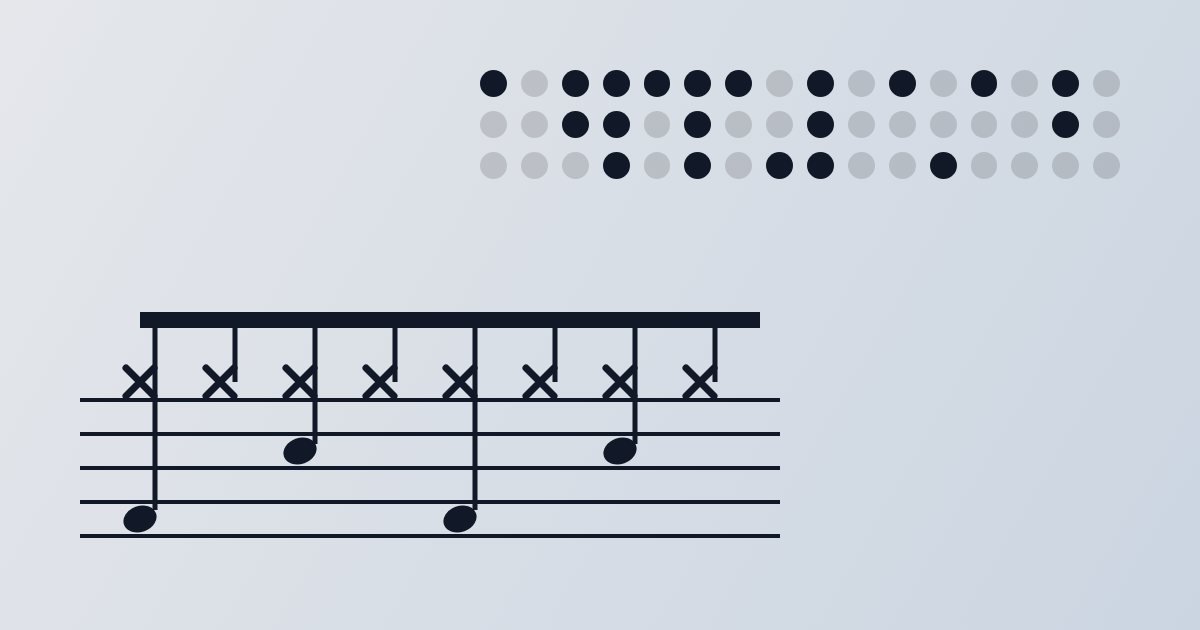
Drum notation looks intimidating, but it’s far simpler than notation for melodic instruments: there are no keys, no sharps and no chords to worry about. You only need to know which drum to hit and when. Give it ten minutes and you’ll be reading every groove in StickHits.
The staff: which drum?
Drum music uses the same five lines as other music, with a percussion clef (two short vertical bars) at the start. Each line or space is a part of the kit. The layout most drummers use:
| Position | Instrument | Notehead |
|---|---|---|
| Ledger line above the staff | Crash cymbal | x |
| Space just above the staff | Hi-hat (played with a stick) | x |
| Top line | Ride cymbal | x |
| Top space | High tom | ● |
| Third space (middle) | Snare | ● |
| Second space | Floor tom | ● |
| Bottom space | Bass drum | ● |
| Below the staff | Hi-hat with the foot | x |
The rule of thumb: cymbals are x’s at the top, drums are round notes, and the lower the note, the lower the drum. Hands usually have stems pointing up, feet stems pointing down.
Note values: when?
Most grooves are written in 4/4 time: four beats per bar, each a quarter note. Count them “1 2 3 4”.
- Quarter notes — one per beat. Count “1 2 3 4”.
- Eighth notes — two per beat, joined by one beam. Count “1 & 2 & 3 & 4 &”.
- Sixteenth notes — four per beat, joined by two beams. Count “1 e & a 2 e & a…”.
- Triplets — three notes in the space of two, marked with a small 3. Count “1 trip let 2 trip let…”.
Notes stacked vertically are played together. A hi-hat x with a bass drum note directly below it means: hit both at the same time.
Rests mark silence for the same lengths. In grooves you’ll mostly see them in the bass drum line, where the feet take a break.
Symbols you’ll meet
- > above a note — accent. Play it louder.
- (note in brackets) — ghost note. Play it very quietly.
- o above a hi-hat note — open hi-hat. Loosen the foot so the cymbals ring.
- + above a hi-hat note — closed hi-hat (after an open one).
- A small note just before a main note — flam (one grace note) or drag (two).
- Slashes through a stem — buzz roll or repeated strokes.
- R and L under notes — sticking: right or left hand.
Read your first bar
Picture this bar in 4/4: eight x’s above the staff, round notes in the middle space on beats 2 and 4, and notes in the bottom space on beats 1 and 3. That’s eighth notes on the hi-hat, snare on 2 and 4, bass drum on 1 and 3 — the most common beat in the world. Count “1 & 2 & 3 & 4 &” and play what lines up with each count.
Tips for reading faster
- Read in beats, not notes. Recognize each beat as a shape — “kick and hat”, “snare and hat” — like reading words instead of letters.
- Look ahead. While playing one bar, glance at the next. In StickHits the current row stays sharp and the next one is visible, so you get used to reading ahead.
- Count out loud the first few times through anything new.
- Read a little every day. Open a new groove, read it before pressing Start, then check with the audio whether you heard it right in your head.
That’s really all there is to it. The rest is practice — and every item in the StickHits library doubles as a reading exercise.
Keep reading
 How to Start Playing Drums: Your First 30 DaysOct 10, 2026 · 4 min readGear you actually need, how to hold the sticks, your first beat and a simple four-week plan that gets you playing songs.
 The 15-Minute Daily Practice Routine That Actually WorksSep 28, 2026 · 2 min readNo time to practice? Fifteen focused minutes a day beat a two-hour weekend session. Here's exactly how to spend them.